“Does a PVC pipe-fitting mold need stainless steel?” is too broad to answer with one grade or one rule. The useful decision is which tool components face credible corrosion or staining exposure, how severe that exposure is, and what combination of steel, inserts, venting, cooling-water control, cleaning, and storage is appropriate for the actual program.
This guide is a buyer-side framework for starting that discussion. It does not prescribe a universal steel grade, hardness, mold life, or maintenance interval. Final selection needs the specified PVC compound, additives, part geometry, finish, production target, molding conditions, plant water, storage environment, and toolmaker/steel-supplier review.
Why PVC changes the steel discussion
PVC can thermally degrade when exposed to excessive heat, residence time, or shear. Westlake’s PVC product-stewardship information warns that prolonged heating at processing temperatures or excessive shear/heat combinations can generate hazardous decomposition products. Its safety data also identifies hydrogen chloride as a decomposition product at elevated temperature. These are material-handling and process warnings; they do not by themselves select a mold steel.
From the tooling side, Uddeholm identifies corrosive materials such as PVC and humid working or storage conditions as applications where corrosion-resistant mold steel can be relevant. It also distinguishes corrosion-resistant mold steels from other tool-steel families rather than saying every component of every PVC mold needs the same material.
The buying implication is straightforward: review exposure by component and by failure mode. Do not reduce the decision to “PVC equals stainless everywhere,” and do not ignore venting, process control, water quality, cleaning, or storage because a corrosion-resistant grade was named in the quotation.
Freeze the resin and process basis first
Ask for the exact commercial compound or the narrowest available material definition. “PVC” can conceal differences in stabilizers, fillers, pigments, flame-retardant systems, recycled-content rules, and supplier processing guidance. Record:
- resin producer and commercial grade;
- rigid PVC, flexible PVC, CPVC, or another specified compound family;
- color, filler, stabilizer, and other known formulation information;
- material-supplier processing and safety guidance;
- allowed regrind or recycled-content rule;
- melt-temperature, residence-time, shear, and shutdown concerns supplied by the material/molding team; and
- who approves a grade or formulation change.
Autodesk’s injection-molding guidance notes that even different grades in one material family may have different properties and that the selected grade affects analysis accuracy. A steel decision made against a generic family name should remain provisional.
Map exposure by mold component
Build an exposure map before comparing steel names. The goal is to identify where corrosion resistance is needed and where other properties—wear, toughness, polishability, thermal conductivity, repairability, or cost—may control the choice.
| Component or zone | Exposure questions | What to compare |
|---|---|---|
| Cavity and core surfaces | Can degraded material or deposits remain on the surface? Is the finish cosmetic, sealing, or dimensional? | Corrosion/staining resistance, polish or texture needs, hardness, repair route |
| Vents and end-of-fill zones | Are burns, deposits, or difficult cleaning expected near trapped gas? | Vent access, cleanability, local insert strategy, process monitoring |
| Gate and runner areas | Will heat, shear, residence time, or dead spots increase degradation risk? | Geometry, temperature control, removable inserts, wear and corrosion balance |
| Slides, lifters, and shut-offs | Can deposits, condensation, or cleaners reach sliding and sealing surfaces? | Toughness, galling/wear control, lubrication, replaceability, corrosion protection |
| Cooling circuits | What is the plant water quality, treatment, shutdown practice, and storage condition? | Internal corrosion strategy, water management, plugs/fittings, cleaning access |
| Mold base and plates | Will the mold see humid production, shipping, or long storage? | Holder/mold-base material, surface protection, drainage, preservation plan |
| Replaceable inserts | Is exposure concentrated in a small, serviceable area? | Local corrosion-resistant insert versus broader material upgrade |
This component view allows a mixed strategy when technically justified. A corrosion-resistant insert in a high-exposure zone may be more appropriate than upgrading every plate; another program may justify broader corrosion resistance because exposure, finish, water, maintenance, or storage risk is widespread. The quotation should explain the boundary.
Treat venting and process control as part of corrosion prevention
Steel cannot compensate for an unstable process or inaccessible venting. Ask the supplier and molder to review:
- likely end-of-fill and gas-trap locations;
- vent depth, land, routing, and cleaning access appropriate to the actual compound and geometry;
- gate and runner areas that could create high shear or long residence;
- temperature-control zones and sensor strategy;
- startup, interruption, shutdown, and purge procedures from the material/molding team; and
- how deposits, burns, discoloration, or unexpected odor will trigger a process stop and investigation.
Do not copy generic vent dimensions into a purchasing specification. Venting depends on the resin, part, surface requirement, process, and tool construction, and an incorrect vent can flash or become ineffective.
Include water, cleaning, and storage in the quotation basis
Corrosion risk is not limited to resin contact. Cooling water, condensation, cleaning chemistry, shipping, and idle storage can expose other tool surfaces.
Ask the receiving plant to provide its water-treatment practice and accepted cooling-circuit materials. Record the planned cleaning agents and confirm their compatibility with tool materials, coatings, seals, and hot-runner or component suppliers. Define who drains, dries, protects, inspects, and records the tool during a shutdown or long storage period.
For an export mold, the preservation package should state:
- which surfaces and circuits are cleaned and dried before packing;
- what removable corrosion protection is applied and where;
- how vents, water lines, connectors, and moving components are protected;
- the unpacking and recommissioning steps; and
- which inspection findings must be reported before production restarts.
A material upgrade without a maintenance and storage plan can leave preventable exposure uncontrolled.
Compare steel proposals by property and component
Ask each supplier to fill a component-level table instead of writing one undifferentiated steel name.
| Quotation field | Required supplier answer |
|---|---|
| Component | Cavity, core, insert, slide, shut-off, runner/gate insert, mold base, plate, or other named item |
| Proposed material | Exact grade and supplier or accepted equivalent rule |
| Supplied/working condition | Delivery condition, heat treatment, target hardness range, and responsible processor |
| Primary reason | Corrosion/staining, wear, toughness, polish, texture, dimensional stability, repair, or another stated requirement |
| Exposure basis | Resin/process, cooling water, humidity/storage, cleaning, or local geometry |
| Maintenance basis | Inspection, cleaning, lubrication, protection, and replaceable-part plan |
| Evidence | Steel-supplier data sheet, material/process guidance, and part-specific DFM notes |
Uddeholm’s public material literature, for example, describes corrosion-resistant mold-steel families with different combinations of polishability, toughness, hardenability, and supplied condition. That supports comparing properties and application demands; it does not prove that a named grade is correct for this project without the inputs above.
Review the steel choice alongside the fitting geometry
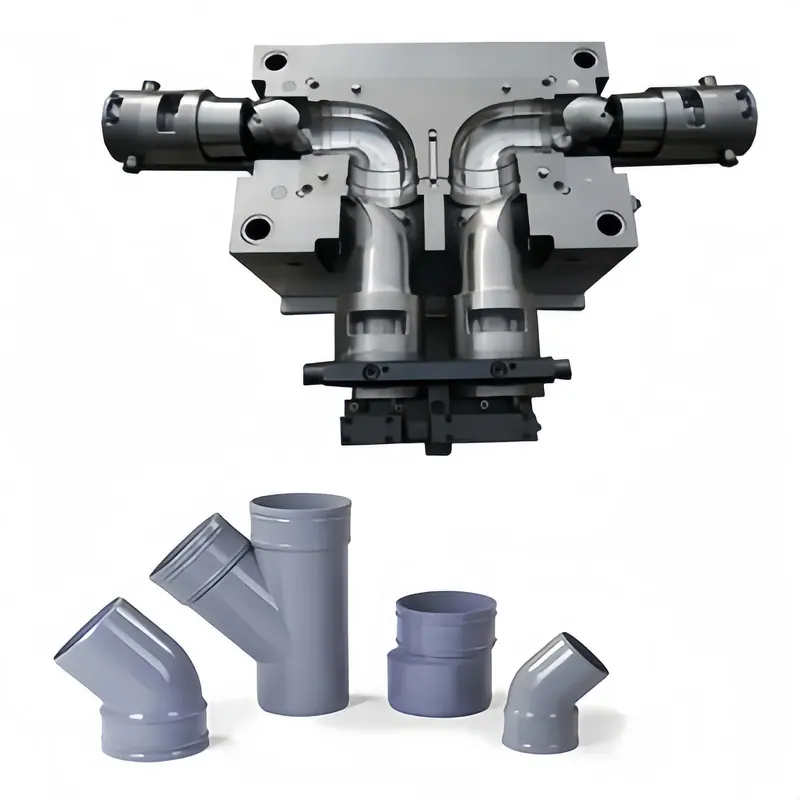
For a tee fitting, ask the supplier to mark the branch cores, connection surfaces, vent access, and replaceable areas on the same tooling concept used for the steel proposal. The PVC tee engineering example provides a geometry-review starting point; its photos do not identify a steel grade.
Keep the decision record short: component → exposure or service requirement → proposed material and condition → supporting data sheet → buyer approval status. Record alternative materials separately so a lower-priced option does not silently replace the approved scope.
Include this record with the pipe fitting RFQ checklist. If two suppliers propose different materials, compare their component boundaries and maintenance assumptions using the quotation scope guide.
Questions that should stop a premature steel approval
Keep the steel decision open when any of these questions cannot be answered:
- Is the exact PVC/CPVC compound confirmed, including relevant additives and supplier guidance?
- Which components have resin-side, water-side, humidity, cleaning, or storage exposure?
- Where are likely gas traps, deposits, dead spots, or difficult-to-clean zones?
- Which surfaces require polish, texture, sealing, or dimensional control?
- Which components also need high wear resistance, toughness, or repairability?
- Is corrosion risk local enough for replaceable inserts, or distributed across the tool?
- What water-treatment, cleaning, shutdown, packing, and storage practices will the receiving plant use?
- What evidence supports the proposed grade, heat treatment, hardness, coating, or insert boundary?
If a supplier cannot state the exposure and property behind a recommendation, the steel label is not yet a complete technical basis.
How this guide was prepared
This guide combines public material and tool-steel references with JF MOULD’s perspective on organizing overseas PVC fitting mold discussions. It is not a published customer case, and it does not claim a universal steel recipe, cycle, mold life, or production result.
Sources and further reading
- Westlake — PVC Suspension Resin Product Stewardship Summary, covering thermal-degradation risk from prolonged heating and excessive shear/heat combinations.
- Westlake — PVC resin safety data, identifying hazardous decomposition products and conditions to avoid; use the current SDS for the actual supplied grade.
- Uddeholm Mirrax ESR technical data, listing corrosive materials such as PVC and humid working/storage conditions among relevant application demands.
- Uddeholm — Tool steels for plastic moulding, comparing plastic-mold steel families and their property/application trade-offs.
- Autodesk Fusion — Materials in an injection molding simulation study, explaining why the actual commercial material grade matters to analysis inputs.
Review the relevant mold and buyer-input context on our pipe-fitting mold page. For a part-specific review, send the fitting model, exact compound status, annual demand, target press, finish requirements, plant water/maintenance information, and current steel proposal through the manual RFQ form.
Next step
Turn this article into an RFQ review.
Send files or a project brief, material, annual volume, or target timing notes. Jessica and the engineering team will review manufacturability risk and reply with initial engineering feedback or quotation planning. First human reply targeted within 24 hours.