
Industrial Components
Industrial Component Mold Manufacturing
Industrial component mold manufacturer for enclosures, handles, reels, battery boxes and engineering plastic parts with durability and assembly focus.
Industrial component mold manufacturer for enclosures, handles, reels, battery boxes and engineering plastic parts with durability and assembly focus.
File ready? Send it now. No CAD yet? One-line brief works.
China injection mold manufacturerDFM supportCustom toolingTrial productionQuality measurementExport experience
Overview
How we evaluate industrial tooling fit
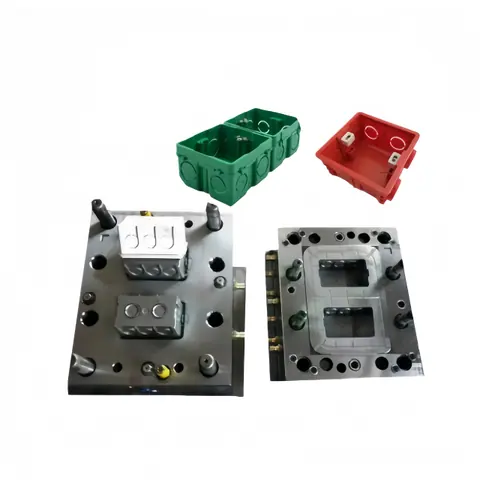
Industrial tooling needs a balance of dimensional discipline, durable steel decisions and practical production support. JF MOULD works on industrial component mold programs for battery boxes, cable reel cores, control enclosures, fan shrouds and connector-related parts used in equipment or factory environments.
If you are comparing an engineering plastic mold partner or a connector mold factory in China, our role is to turn the application requirement into a mold that runs predictably. We review assembly interfaces, resin behavior, expected load conditions and maintenance access before finalizing the tool concept.
Procurement Check
What the quotation should make explicit
These items are project-specific. Confirm them in the written quotation instead of assuming a fixed MOQ, sample policy, lead time, or shipping boundary.
| Quote inputs | Send the part file, resin grade, annual volume, cavity target, assembly interfaces, critical tolerances, load conditions, and any required validation method. |
|---|---|
| Trial and samples | Define trial stages, sample quantity, dimensional or functional checks, correction ownership, and acceptance criteria in the quotation. |
| Delivery boundary | Tool lead time is confirmed after DFM. Export packing, interface standards, spares, documentation, and freight handoff should be explicit line items. |
| Incoterm | Confirm the Incoterm and named place. Import clearance, duties, destination charges, and on-site support are excluded unless the quotation states otherwise. |
Capabilities
What we focus on for industrial mold builds
Engineering plastic mold planning
We support PP/PA mold and reinforced material discussions for industrial parts that need stiffness, impact resistance or temperature stability in use.
Assembly-focused enclosure tooling
Industrial component mold projects often include mating surfaces, screw bosses and snap features. We design around those interfaces so downstream assembly is more predictable.
Wear-aware production design
For connector mold factory and gear mold factory style inquiries, we consider core wear zones, maintenance access and production lifetime early to protect long-run tooling value.
Technical Examples
Industrial tooling questions buyers review before RFQ
Technical ExampleEngineering review before quotation
IndustrialHeavy-duty battery box Mold Technical Review
A quotation-stage heavy-duty battery box technical example covering geometry, engineering questions, buyer inputs, and acceptance planning without claiming a completed customer project.
- Review focus
- Review focus: Review mating faces, bosses, ribs, wall transitions, openings, inserts or threads, draft, parting lines, and ejection areas against the buyer's part file.
- Buyer inputs
- Buyer inputs: Provide the part file, resin grade, annual volume, cavity target, machine limits, critical tolerances, assembly interfaces, load conditions, and validation method.
Technical ExampleEngineering review before quotation
IndustrialControl enclosure Mold Technical Review
A quotation-stage control enclosure technical example covering geometry, engineering questions, buyer inputs, and acceptance planning without claiming a completed customer project.
- Review focus
- Review focus: Review mating faces, bosses, ribs, wall transitions, openings, inserts or threads, draft, parting lines, and ejection areas against the buyer's part file.
- Buyer inputs
- Buyer inputs: Provide the part file, resin grade, annual volume, cavity target, machine limits, critical tolerances, assembly interfaces, load conditions, and validation method.
Technical ExampleEngineering review before quotation
IndustrialFan shroud Mold Technical Review
A quotation-stage fan shroud technical example covering geometry, engineering questions, buyer inputs, and acceptance planning without claiming a completed customer project.
- Review focus
- Review focus: Review mating faces, bosses, ribs, wall transitions, openings, inserts or threads, draft, parting lines, and ejection areas against the buyer's part file.
- Buyer inputs
- Buyer inputs: Provide the part file, resin grade, annual volume, cavity target, machine limits, critical tolerances, assembly interfaces, load conditions, and validation method.
Ready to request a quote after these examples?
Send the part file or a short project brief before you keep browsing more case pages.
Buyer Questions
Questions we hear during industrial RFQs
Use these questions to judge fit before you send your RFQ.
What industrial plastic parts are a good fit?
We support battery boxes, enclosures, handles, reel cores, fan shrouds and similar engineered plastic components. Customers usually come to us through industrial component mold, engineering plastic mold or connector mold factory searches and then refine the scope from there.
Can you work with PP, PA or reinforced materials?
Yes. Material selection changes gate design, venting, shrinkage and wear behavior. For PP/PA mold jobs, we review the application conditions early so the mold structure matches both the resin and the production target.
What makes an industrial mold last in production?
We focus on practical service life: steel choice, cooling layout, wear-prone zones and maintenance access. Industrial component mold buyers usually care as much about uptime and repeatability as they do about the first sample result.
Can you support connector-style or gear-style components?
We can support connector-like and mechanically functional components where interface accuracy matters. During quotation, we will confirm geometry, resin and performance expectations to decide whether the tooling should prioritize wear resistance, cavity repeatability or easier maintenance.
What proof should we review before sending an industrial RFQ?
Review similar part photos, molded samples, resin notes and any assembly-risk comments. For industrial parts, proof around fit, wear zones and maintenance access is more useful than a generic capability list.